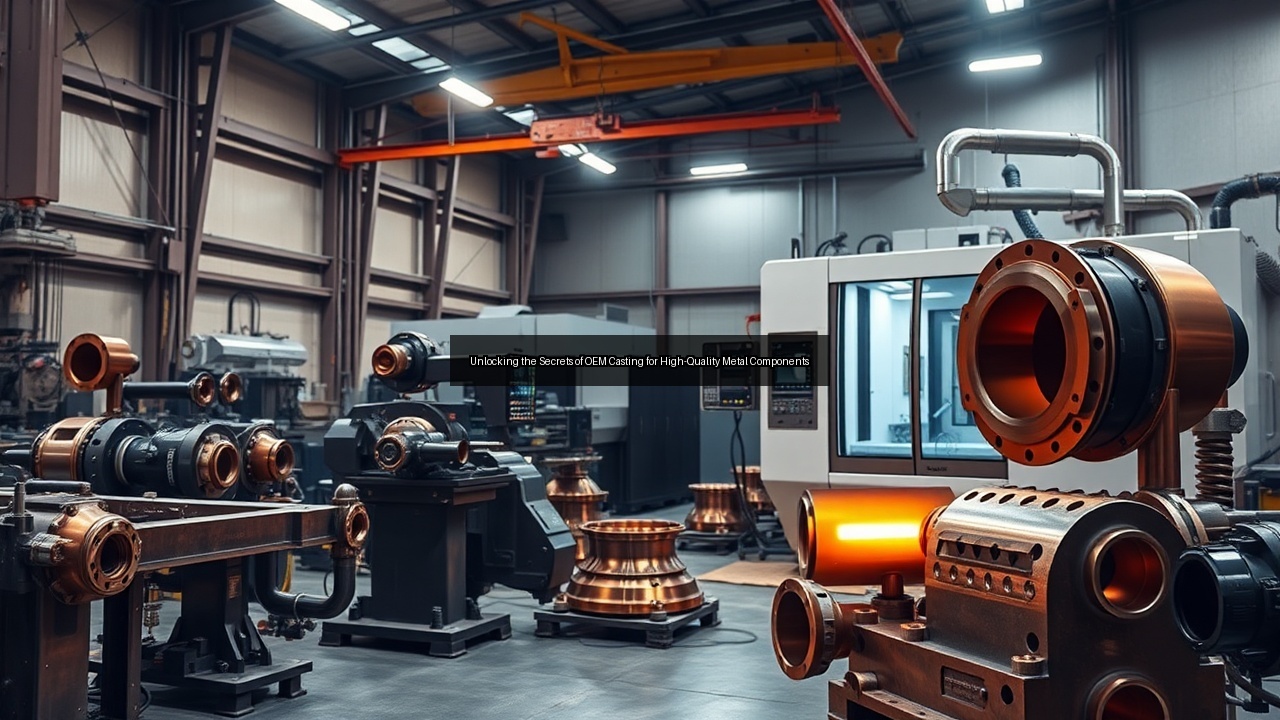
Unlocking the Secrets of OEM Casting for High-Quality Metal Components
Understanding OEM Casting and Its Importance
Definition and Overview of OEM Casting
OEM casting refers to the process of producing high-quality metal components for Original Equipment Manufacturers (OEMs). This method involves pouring molten metal into a mold to create intricate shapes and designs tailored to specific requirements. OEM casting plays a crucial role in manufacturing various products, from automotive parts to industrial machinery. The precision achieved through OEM casting ensures that components fit seamlessly within larger assemblies, enhancing overall performance and reliability. As industries continue to innovate, the need for customized, high-quality components has made OEM casting an indispensable part of modern manufacturing processes.
Advantages of OEM Metal Casting for Manufacturers
OEM metal casting offers numerous advantages that significantly benefit manufacturers. First, it allows for high precision and repeatability, essential for producing components that meet stringent quality standards. The ability to create complex geometries without additional machining saves time and reduces production costs. Moreover, OEM casting enables the use of various materials, including aluminum, ductile iron, and cast iron, providing manufacturers with flexibility in material selection based on performance requirements. Additionally, OEM castings support lightweight designs, particularly critical in industries such as aerospace and automotive, where weight reduction directly impacts fuel efficiency and performance.
Applications of OEM Castings in Various Industries
OEM castings find applications across diverse industries, showcasing their versatility and adaptability. In the automotive sector, OEM castings produce engine blocks, transmission housings, and suspension components, all of which require durability and precision. The aerospace industry also relies on OEM castings for critical parts, including landing gear and turbine housings, where performance and safety are paramount. Furthermore, OEM metal casting is essential in the manufacturing of machinery components for construction and industrial equipment. This adaptability makes OEM castings a cornerstone in sectors ranging from consumer electronics to heavy machinery, driving efficiency and innovation.
Key Metal Casting Processes Used in OEM Manufacturing
Investment Casting: Precision and Versatility
Investment casting, also metal casting for OEMs known as lost-wax casting, stands out for its precision and versatility. This process involves creating a wax pattern, coating it with a ceramic shell, and subsequently melting out the wax to leave a mold. The molten metal is then poured into the mold, resulting in highly detailed castings. This method excels in producing components with intricate shapes and fine features, making it ideal for industries that demand high accuracy, such as aerospace and medical devices. Investment casting also supports a wide range of materials, including aluminum, stainless steel, and titanium, allowing manufacturers to choose the best option for their applications.
Die Casting: High-Volume Production Efficiency
Die casting is a popular choice for high-volume production due to its efficiency and speed. In this process, molten metal is injected into steel molds under high pressure, creating uniform and precise components. Die castings are particularly favored in the production of aluminum parts, as they offer excellent surface finishes and dimensional accuracy. This method is ideal for manufacturing complex shapes and can produce thousands of parts quickly, making it cost-effective for large-scale operations. Industries such as automotive, electronics, and consumer products rely heavily on die casting to meet their growing demands for quality and efficiency.
Sand Casting: Cost-Effectiveness and Customization
Sand casting remains one of the oldest and most versatile metal casting processes, providing a cost-effective solution for producing metal components. This method involves creating a mold from sand, which is then packed around a pattern to form a cavity. The molten metal is poured into this cavity to create the desired shape. Sand casting excels in producing large components and allows for easy customization, making it suitable for both low and high-volume production. Industries often leverage sand casting for its flexibility and ability to accommodate various materials, including cast iron and ductile iron, leading to high-quality finished products.
Forging vs. Casting: Choosing the Right Method
Understanding the differences between forging and casting is essential for selecting the right manufacturing method. Forging involves shaping metal using compressive forces, resulting in a dense and strong material. It is ideal for components that require high strength-to-weight ratios, such as crankshafts and gears. In contrast, casting allows for more complex shapes and intricate designs that forging cannot achieve. While forging typically provides superior mechanical properties, OEMs often choose casting for its versatility and lower production costs. Each method has its advantages, and the decision ultimately depends on the specific requirements of the component being manufactured.
Materials Used in OEM Casting
Iron and Its Alloys: Ductile Iron vs. Cast Iron
Iron and its alloys serve as fundamental materials in OEM casting, with ductile iron and cast iron being the most prominent. Ductile iron, also known as spheroidal graphite iron, features enhanced strength and ductility, making it ideal for applications requiring high impact resistance, such as automotive components and heavy machinery parts. In contrast, cast iron offers excellent wear resistance and machinability, making it suitable for applications like engine blocks and pipes. Each material has distinct properties that cater to different manufacturing needs, allowing OEMs to optimize performance based on specific application requirements.
Aluminium Castings: Lightweight Solutions for OEMs
Aluminum castings provide a lightweight and corrosion-resistant solution for OEMs across various industries. The low density of aluminum allows for significant weight reductions in components, which is crucial in sectors like aerospace and automotive, where every ounce counts. Aluminum castings also offer excellent thermal conductivity and strength, making them suitable for applications such as engine components and housings. Furthermore, the versatility of aluminum allows for various casting methods, including sand casting and die casting, providing manufacturers with flexibility in production while maintaining high quality and performance.
The Role of Machining in Enhancing Cast Quality
Machining plays a vital role in enhancing the quality of OEM castings. After the casting process, components often require precision machining to achieve the desired tolerances and surface finishes. CNC machining, in particular, has revolutionized the post-casting process by enabling highly accurate cuts and shapes. This technology allows for the removal of excess material and the refinement of critical features, ensuring that the final product meets the stringent specifications required by OEMs. By integrating machining with casting processes, manufacturers can produce components that not only meet but often exceed performance expectations.
Selecting an OEM Manufacturer for Metal Castings
Criteria for Choosing a Reliable OEM Foundry
Selecting a reliable OEM foundry is crucial for ensuring high-quality metal castings. First, assess the foundry's experience and expertise in your specific industry, as this knowledge can significantly affect the quality and efficiency of production. Additionally, consider the foundry's technological capabilities. A modern foundry equipped with advanced machinery and casting processes can offer better precision and faster turnaround times. Quality certifications, such as ISO 9001, provide assurance of the foundry's commitment to maintaining high standards in manufacturing, ultimately leading to superior products for OEMs.
The Importance of CNC Machining in the Casting Process
CNC machining is integral to the casting process, enhancing the final product's precision and quality. After casting, many components require additional machining to achieve tight tolerances and specific surface finishes. CNC machines allow for automated and highly accurate machining processes, reducing human error and improving consistency across batches. The combination of casting and CNC machining streamlines production and provides OEMs with components that meet rigorous specifications. This integration not only enhances efficiency but also ensures that the end product aligns with the quality standards expected in today's competitive markets.
Quality Control Measures in OEM Casting Production
Implementing robust quality control measures is essential in OEM casting production to guarantee the integrity and performance of metal components. Effective quality control begins with material selection, ensuring that only the best materials are used for casting. Regular inspections throughout the casting process, including dimensional checks and surface quality assessments, help identify any defects early on. Additionally, implementing non-destructive testing methods, such as ultrasonic or radiographic testing, allows manufacturers to detect internal flaws without damaging the components. By prioritizing quality control, OEM manufacturers can deliver reliable and high-performance castings that meet or exceed customer expectations.
See Also
- Maximizing Efficiency in the OEM Casting Process with Advanced Techniques
- Transforming Designs into Reality with OEM Casting Capabilities
- The Benefits of Ductile Iron in OEM Casting Applications
- Die Casting vs Sand Casting Which is Best for OEM Manufacturers
- The Future of OEM Casting Trends to Watch in Metal Manufacturing